How to Solve Mini Sudoku Faster: 7 Strategies That Actually Help
Playing Mini Sudoku for the first time? Stop here and read how to play 6x6 Sudoku first.
Want to solve Mini Sudoku faster? The 6x6 grid rewards a specific approach — and once you nail it, you can go from 8 minutes to under 3. Here are the 7 strategies that actually move the needle.
Continue reading to learn 6x6 Sudoku tips that will help you become an even more efficient solver!
Why Mini Sudoku Gets Faster Once You Change Your Approach

A 6x6 Sudoku grid can be solved fast and accurately with the right approach. The average playtime ranges between 5 and 10 minutes, but efficient solvers can do it between 3 and 5 minutes.
That speed doesn't come from rushing, but pattern recognition and good Mini Sudoku strategy, and both can't be achieved by rushing or stubbornly focusing on a logic path that you decided before you even assessed the grid.
Unlike the classic 9x9 Sudoku, the 6x6 variant better rewards small, consistent habits, which turn into a quickly learned routine. And in logic puzzles, an effective routine is the same as going up a step in overall skill.
Key Skills for 6x6 Sudoku Speed-Solving & Eliminating Numbers
In Mini Sudoku, here are the key things to remember in learning how to solve fast:
⭐ Haste ≠ Accuracy
⭐ Knowing advanced techniques from classic Sudoku (X Wing pattern, Swordfish, etc.) ≠ Easy puzzles when playing Sudoku 6x6
⭐ Accuracy translates to solving speed
⭐ Accuracy depends on grid scanning and a firm grasp of the basics
7 Mini Sudoku Strategies for Speed-Solving
1. Start with the most constrained row, column or box
- Look for units with the most givens, and if you don't know what a given is, stop reading here and learn common Sudoku terms first
- Logically, the more numbers there are in a row, column or box, the faster and easier it is to fill, and there's less room for error
- Solving for one has a cascading effect — filling in gives way for other parts of the grid to be solved
2. Scan by missing numbers, not by empty cells
- Scanning is a basic skill that needs to be mastered before trying to speed-solve
- Pick one number and trace where it can go across the board
- Don't jump around the grid looking for empty cells and filling them in randomly
- Continuous tracing eventually fills in cells that turn into forced placements
3. Use pencil marks when the grid tightens up
- Pencil marks help the most when the grid is already partially filled, and if you don't know what Sudoku pencil marking is, stop here and read that first
- 9x9 Sudoku uses pencil marks from the start, as there are a lot more cells to work with
- In Mini Sudoku, there are only 36 cells, so it's easier to start off with partial filling in
- Pencil marks stop making you faster when you end up focusing on pencil marking every single cell — this turns into clutter and slows you down
- Use them for light note-taking for areas of the grid that make you uncertain
- Candidates are great for spotting hidden singles by creating naked pairs or triples
4. Look for naked singles & hidden singles first
- Naked singles are when a cell has only one candidate, or you've whittled the candidates to one
- Hidden singles are when a cell has multiple candidates, but a specific digit is singled out among them after scanning relevant rows, columns and boxes because it has nowhere else to go
- These two singles are the most basic and useful speed-solving moves not just in 6x6 Sudoku, but also in the classic 9x9
5. Re-scan the whole grid after every placement
- Don't get tunnel vision — beginners get stuck because they focus too much on a certain area
- Most players miss easy follow-up moves because they aren't looking at the whole grid
- Scanning is pivotal in ensuring board-wide sweeps
- Every cell you fill in affects the board, making adjacent or relevant cells easier to solve, like a domino effect
6. Stop these common time-wasting mistakes
❌ Random jumping around the grid
❌ Guessing too early
❌ Ignoring the 2x3 box
❌ Overusing pencil marks
❌ Failing to revisit easy units after new placements
7. Practice with a repeatable fast-solve routine
✅ An easy-to-follow and logical solving loop is key to becoming a 6x6 Sudoku speed-solver
✅ Think of it like using a checklist every game, taking note of certain triggers or conditions and acting based on them
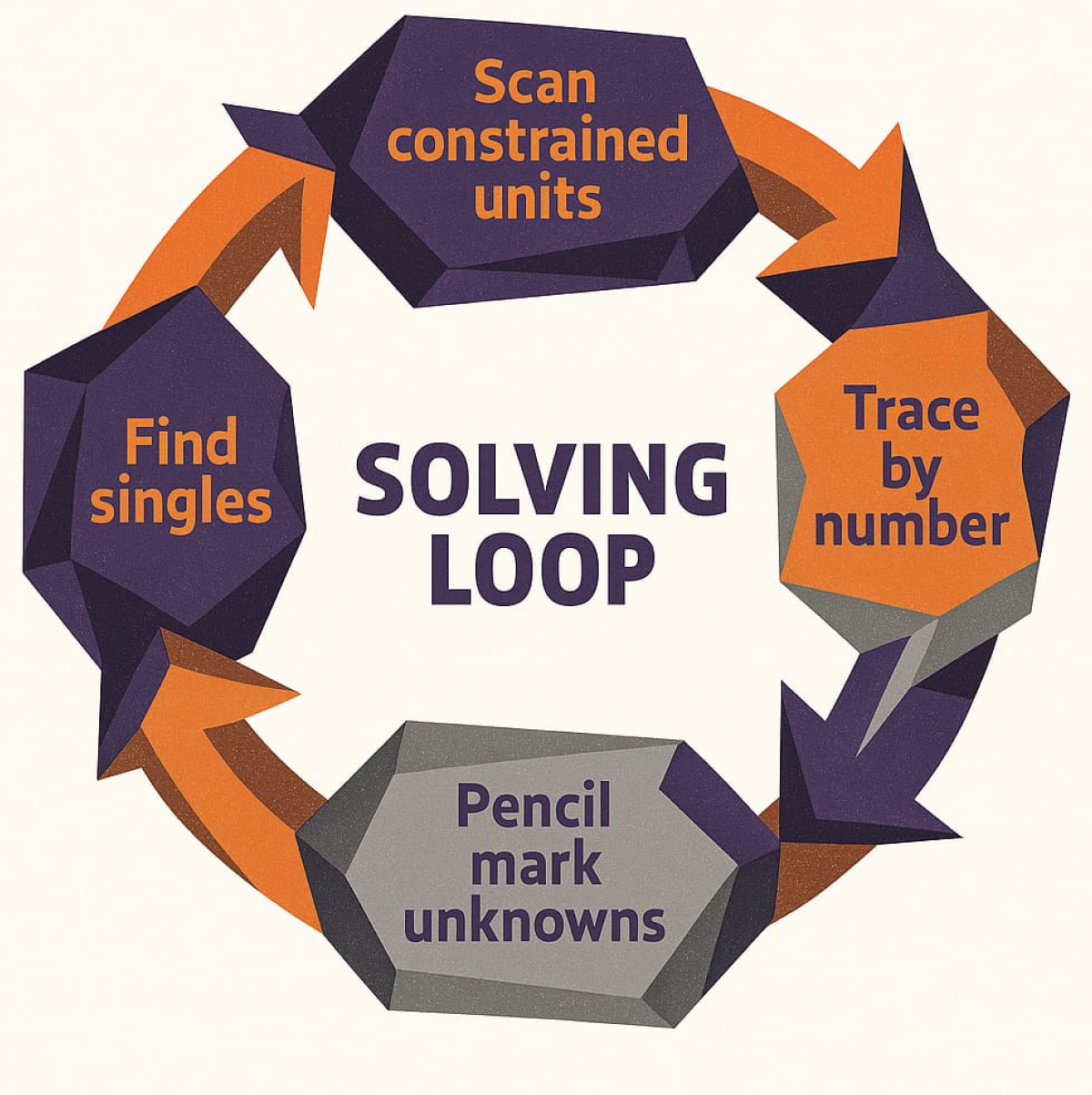
✅ Here's a basic loop you can follow: scan constrained rows, columns or boxes > trace by number > pencil mark cells with unknowns > find hidden or naked singles > re-scan > repeat
✅ Repetition turns into routine, routine turns into accuracy, accuracy turns into improved speed & skill
✅ Most players who follow this loop consistently cut 2-3 minutes off their average solve time within a week of practice.
FAQ
Is Mini Sudoku easier than regular Sudoku?
Yes, it is. It has fewer cells to solve for and is designed to be a faster and more accessible variant of Sudoku. However, it can be adjusted to be more difficult depending on player preference.
What's the best first move in Mini Sudoku?
Start with the most constrained unit — the row, column, or 2x3 box that already has the most numbers filled in.
In a 6x6 grid, if a row already has 4 of 6 numbers, you only have 2 cells left to solve. That's the easiest win on the board and it often creates a chain reaction that opens up adjacent units. Find that unit first, fill it, then re-scan the whole grid before moving on.
What's the fastest way to improve at 6x6 Sudoku?
👉 Grasp the basics first
👉 Follow an effective routine
👉 Consistently repeat to build skill
Should you use pencil marks in Mini Sudoku?
Yes. Especially when the grid starts to tighten up or if there are too many unknown variables (too few given numbers, no adjacent digits, etc.)
How long should a Mini Sudoku puzzle take?
The average player can solve it in around 5-10 minutes. An amateur speed solver can solve it in 3-5 minutes. An expert can solve it in less than 2 minutes.
Play More Mini Sudoku to Build Speed Today!
We hope that our brief guide was able to teach you how you can improve your 6x6 Sudoku solving speed.
Ready to try out what you've learned? The fastest way to get faster is reps. Play Mini Sudoku Unlimited Mode and put these 7 strategies to work — no streak on the line, just pure practice.
Feeling confident? Test your skill with the classic 9x9 Sudoku instead!
 Mini Crossword
 Midi Crossword
 Diffle
 Killer Sudoku
 Numberle