6x6 Sudoku: Rules, How to Play & Beginner Tips
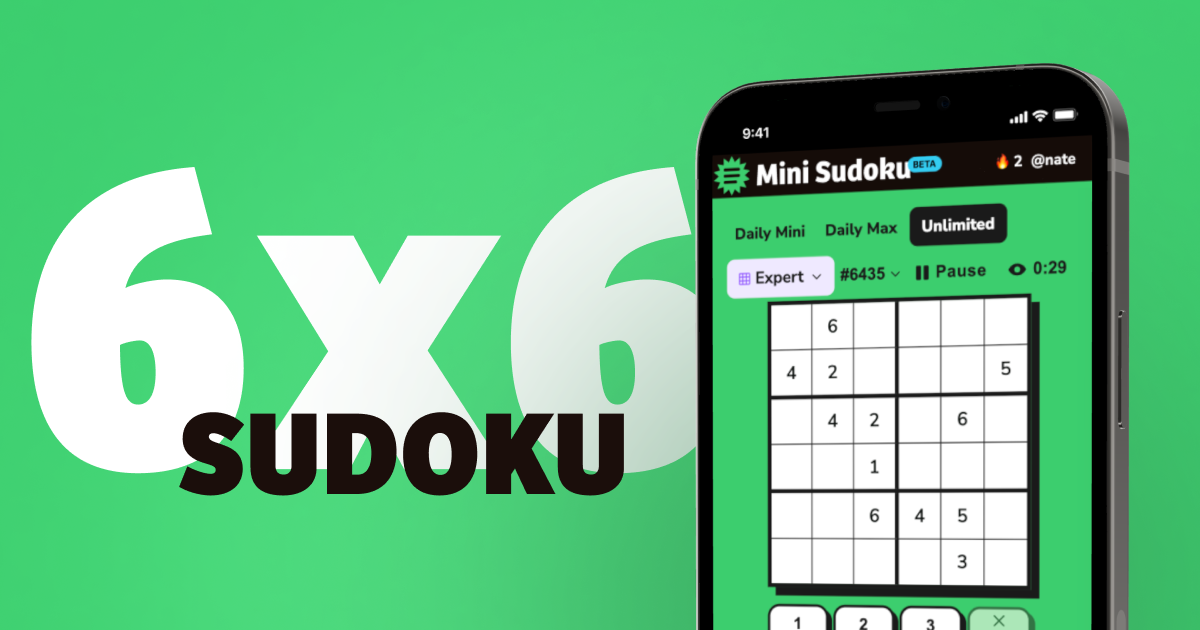
Sudoku has been around for a very long time, and has remained a classic pastime for long-time fans and newcomers alike. The well-known 9x9 square number puzzle grid is easily recognizable from afar, and is enjoyed by many in both its sheet puzzle and digital form.
But did you know it has many variants? Some are made to be harder with bigger grids, and some are made simpler and faster with smaller grids.
6x6 Sudoku is one of the more beginner-friendly sudoku puzzle variants — and it's perfect for kids ages 6 and up, or anyone new to the game. 6x6 sudoku introduces kids to logic puzzles in a format that's manageable and fun, without the overwhelming scale of the classic grid.
Brief History of Sudoku
Sudoku’s roots go way back to the 18th century, when mathematician Leonhard Euler came up with “Latin Squares,” grids where numbers couldn’t repeat in rows or columns.
Fast forward to 1979 in the U.S., Howard Garns designed a puzzle called Number Place for Dell magazine—basically the prototype of the first modern Sudoku.
Japan's Nikoli picked it up in 1984, renamed it Sudoku (short for “digits must be single” in Japanese), and it blew up there. By the early 2000s, British newspapers like The Times started printing it, and suddenly the whole world was hooked.
The traditional sudoku puzzle we know today traces directly back to these origins — and the 6x6 is simply a modern, accessible evolution of that same format.
Read a more in-depth summary of Sudoku →
Sudoku Variants Quick Summary
With its great popularity and replayability, Sudoku gave birth to an extended family of variants that alter the rules and mechanics in different ways:
- Killer Sudoku throws in cages with sum requirements, so players are doing both arithmetic and placements.
- Samurai Sudoku sprawls across five overlapping grids, basically a mega-puzzle that is made in such a way that only the more experienced Sudoku players can solve it.
- Hyper Sudoku adds extra shaded regions that demand the full 1–9 set, layering constraints on top of the usual ones.
- Jigsaw Sudoku breaks the usual symmetric boxes into different shapes, forcing players to rethink spatial logic.
- Sudoku X makes both diagonals part of the game, so players can’t ignore those lines anymore.
- Multi Sudoku links grids together, meaning one number appears in another puzzle, and one move can ripple across multiple boards. We don't recommend this variant in particular for newbies, as it can get really confusing.
- Alphabet Sudoku swaps numbers for letters, turning it into a word-flavored twist.
- Thermo Sudoku uses thermometer shapes where digits must increase from bulb to tip.
- Arrow Sudoku has arrows pointing to sums that must match the circle they feed into.
- Chess Sudoku borrows from the chessboard, banning repeats based on knight moves or other piece restrictions.
There are a lot more Sudoku offshoots, but today, our topic will focus on the classic 9x9 and the mini 6x6.
What Is 6x6 Sudoku?
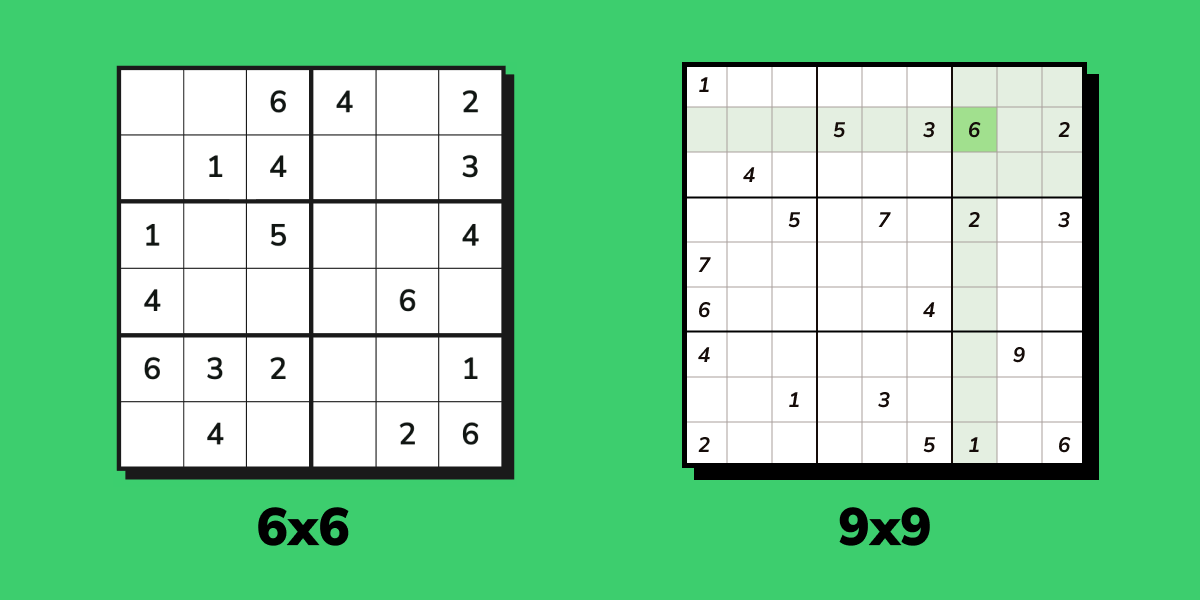
This type of Sudoku is a mini variant of the classic Sudoku. To make it easier to understand, here's a comparative table explaining the differences:
Feature | Classic 9x9 | Mini 6x6 |
Grid size | 9x9 | 6x6 |
Numbers used | 1 to 9 | 1 to 6 |
Box size | 3x3 | 2x3 |
Cell count | 81 | 36 |
Average playtime | 10-30 mins | 5-10 mins |
Unlike the traditional sudoku puzzle, the 6x6 version is compact enough to finish in a single sitting — no prior experience needed.
Each sudoku puzzle — whether 6x6 or 9x9 — has one unique solution that requires pure logic to reach.
6x6 Sudoku is, simply put, a smaller version of the classic 9x9. It's a faster sudoku puzzle and a better choice for newcomers because the grid is less intimidating and easier to correct errors in.
Aside from the smaller grid and fewer numbers to solve with, everything, from the core logic to the rules, is the same.
6x6 Sudoku Rules
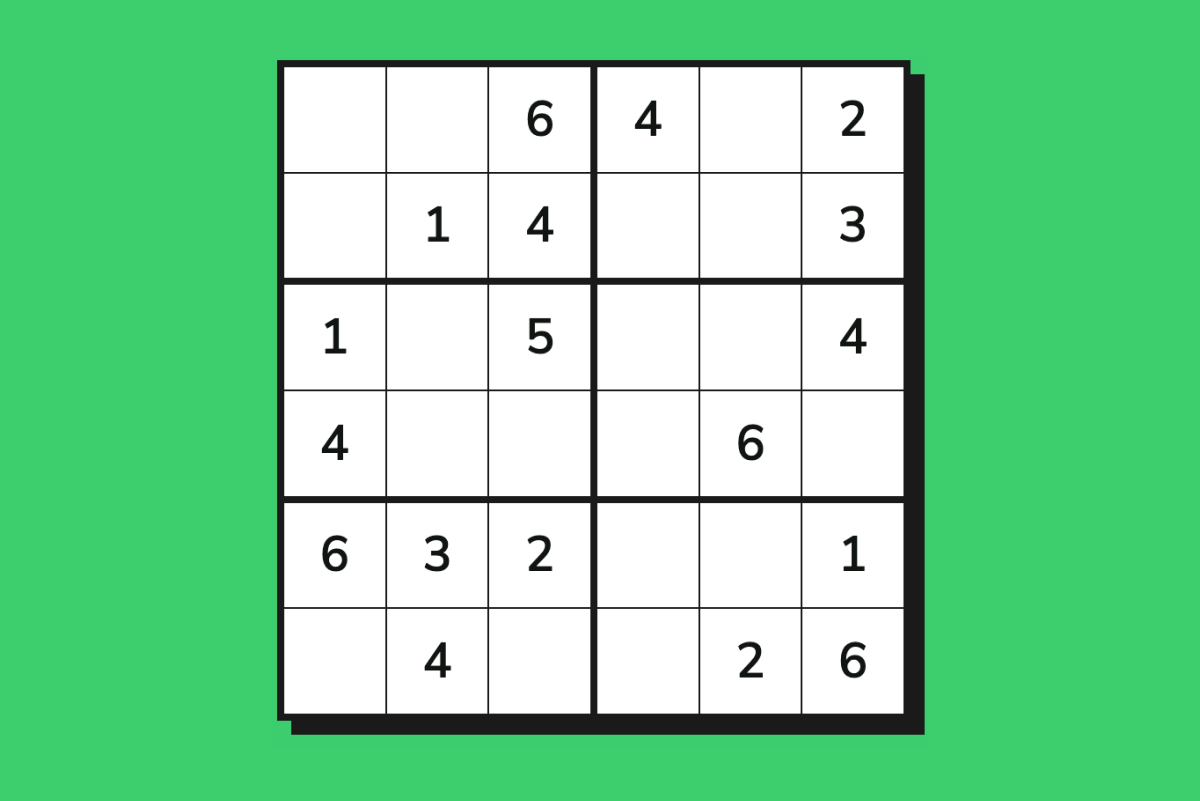
Like every sudoku puzzle, the 6x6 starts with pre-filled numbers already placed in the grid. These are your clues — work from them to fill in the rest. The grid comes with pre-filled numbers that vary by difficulty — more givens for easy mode, fewer for hard.
Just like the classic 9x9, the rules remain as they have, just smaller in scale:
✅️ Each row must contain numbers 1-6 exactly once
✅️ Each column must contain numbers 1-6 exactly once
✅️ Each 2x3 box must contain numbers 1-6 exactly once
Keep in mind, the same techniques used on the 9x9 apply to the 6x6 as they are logic-based. However, you'll need to adjust them a bit, as the grid is significantly smaller.
How to Play Mini Sudoku: Step-by-Step
Mini 6x6 Sudoku is easy to grasp! Here's a basic logic cycle you can follow:
- Scan the 6x6 sudoku puzzle grid and note where the pre-filled numbers are already placed
- Start with rows or columns that already have the most numbers filled in
- Fill obvious or easy cells first, but remember to look at WHICH numbers are missing, not the blank cells
- For every placement, check if there are possible conflicts per row, column and box
- Look at each 2x3 box for missing numbers
- See if there are placeable numbers in them to narrow down possibilities
- Re-scan the grid after every placement
Every sudoku puzzle has one unique solution. If you're stuck, re-scan rows and columns rather than guessing.
Remember, Sudoku is a logical puzzle—there's no need for guesswork. Just remember the rules and core logic, and you'll solve the 6x6 grid faster and more accurately than you think.
Beginner Tips to Solve 6x6 Sudoku Faster
Want to solve faster or lessen errors? Here are a few tips to keep in mind:
👉 Start with the most constrained areas
👉 Scan by number, not just by empty cell
👉 Use pencil marks when needed. Pencil marks are small temporary numbers you write in a cell to track possibilities
👉 Don't bounce randomly around the grid, even if you feel like you're stuck at a section
👉 Re-check boxes after every solved cell
These same tips apply to any sudoku puzzle, whether you're playing a 6x6 or the classic 9x9.
Common Mistakes New Players Make
For newcomers, there's always going to be mistakes, and here are the most common ones:
❌ Forgetting to check the 2x3 boxes
❌ Moving too fast, bouncing randomly around the grid and duplicating a number in a row/column
❌ Guessing when stuck
❌ Treating it like trial-and-error instead of logic
❌ Ignoring obvious single-cell fills
Avoiding these mistakes will make any sudoku puzzle much easier to work through from start to finish.
Where to Play 6x6 Sudoku Online
Start a new game anytime — Mini Sudoku's Unlimited Mode lets you play as many sudoku puzzles as you want, at any difficulty, for free.
✅️ Completely free, no paywalls, no signup required
✅️ Playable on any browser
✅️ Very mobile-friendly
✅️ Compact and fast,
✅️ Daily Mini and Max Modes
✅️ Unlimited Mode for practice and infinite fun
✅️ Choose your level of challenge
FAQ
Is 6x6 Sudoku easier than classic Sudoku?
Generally, yes — a 6x6 sudoku puzzle has fewer cells and a simpler grid, making it much faster to learn. However, there are sites like MiniSudoku.com that offer adjustable difficulty settings.
What age is 6x6 sudoku good for?
6x6 sudoku is great for kids ages 6 and up. The smaller grid makes it an ideal first sudoku puzzle before moving to the classic 9x9.
Can beginners learn Sudoku with 6x6 first?
Absolutely. We actually recommend starting with a 6x6 sudoku puzzle before tackling the classic 9x9, as it is more beginner-friendly.
Is Mini Sudoku the same as 6x6 Sudoku?
Yes. MiniSudoku.com is a 6x6 Sudoku.
How long does a 6x6 Sudoku puzzle take?
Even for newcomers, a 6x6 Sudoku puzzle takes around 5-10 minutes.
Try 6x6 Sudoku Online Now!
We hope that we were able to teach you what 6x6 Sudoku is, its rules and how to play it. There are more grid puzzles and number games out there, but if you want to play something simple to grasp without the numbers, we highly recommend Queens Ultimate: logic puzzle.
 Mini Crossword
 Midi Crossword
 Diffle
 Killer Sudoku
 Numberle